
5-Amino-1MQ (10 mg Vial) Research Protocol

5-Amino-1MQ Research Reference

5-Amino-1MQ research information is provided for educational and laboratory reference purposes. A 10 mg vial format may be referenced with concentration information for research documentation. This information is intended for research reference only and does not provide instructions for human use.
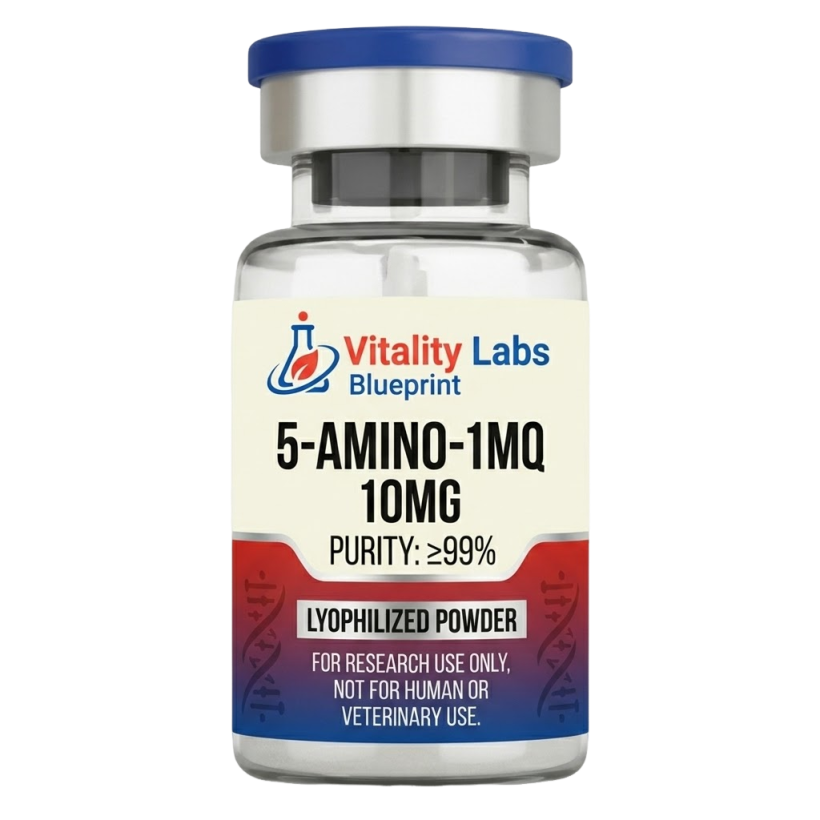
5-Amino-1MQ is a selective, cell-permeable NNMT (Nicotinamide N-methyltransferase) inhibitor studied in research settings for its interaction with cellular metabolic pathways. Research has investigated NNMT activity and its relationship with nicotinamide metabolism and related cellular processes. This educational information provides research reference details for the 10 mg vial format.

Subcutaneous, once or twice daily

Subcutaneous Protocol (2 mL = 5 mg/mL)

PhaseDaily Dose (mg)Units (per injection) (mL)
Days 1–2 (Tolerance)2.5 mg (2500 mcg)50 units (0.50 mL)
Days 3+ (Standard)5 mg (5000 mcg)100 units (1.00 mL)
Alternative BID2.5 mg twice daily50 units (0.50 mL) × 2
Frequency: Inject once or twice daily subcutaneously. Due to the compound’s plasma half-life of approximately 3.8–6.9 hours, twice-daily (BID) dosing may provide more sustained NNMT inhibition. A single 10 mg vial provides 2–4 days of material at these doses.

Reconstitution Steps

Important: This guide is for educational purposes only and is not medical advice.

Plan based on protocol duration using the 10 mg vial format at 5 mg/day.
Concise summary of the research reference information for the 10 mg vial format.

Proper storage preserves peptide quality and stability.

Practical considerations for research documentation and handling.

5-Amino-1MQ (5-amino-1-methylquinolinium) is a synthetic small molecule studied for its interaction with Nicotinamide N-methyltransferase (NNMT). NNMT is an enzyme involved in nicotinamide metabolism and cellular research pathways. Research studies have investigated NNMT activity and its role in related biochemical processes.

Research involving NNMT inhibition has focused on understanding its relationship with nicotinamide metabolism and related cellular mechanisms. This information is provided for educational and research reference purposes only.

Observations from preclinical and early research literature related to 5-Amino-1MQ research.

Complementary strategies for best outcomes.

General subcutaneous guidance from clinical best-practice resources.

We recommend Vitality Labs Peptides for high-purity 5-Amino-1MQ (10 mg).

Why Vitality Labs Peptides?

This content is intended for research and educational purposes only and does not constitute medical advice, diagnosis, or treatment.

Explore related research references and background information for 5-Amino-1MQ and NNMT research.

Nature Medicine (2014)

— Nicotinamide N-methyltransferase knockdown protects against diet-induced obesity

PMC (2024)

— Nicotinamide N-methyltransferase inhibition mitigates obesity-related metabolic dysfunctions

Frontiers in Pharmacology (2024)

— NNMT: a novel therapeutic target for metabolic syndrome

ResearchGate (2021)

— Combined NNMT inhibition and reduced-calorie diet normalizes body composition in obese mice

PMC (2022)

— Reduced calorie diet combined with NNMT inhibition establishes a distinct microbiome in DIO mice

Scientific Reports

— Research findings related to NNMT inhibition and cellular pathways

Journal of Medicinal Chemistry (ACS)

— Bisubstrate inhibitors of NNMT with enhanced activity

5-Amino-1MQ Research Reference

5-Amino-1MQ research information is provided for educational and laboratory reference purposes. A 10 mg vial reconstituted with bacteriostatic water yields a concentration reference of approximately 5 mg/mL. This information is intended for research reference only and does not provide instructions for human use.
5-Amino-1MQ dosage protocols center on this selective, cell-permeable NNMT (Nicotinamide N-methyltransferase) inhibitor studied for its potential to support fat metabolism, preserve lean muscle mass, and elevate intracellular NAD+ levels. By blocking NNMT, 5-Amino-1MQ may help restore cellular energy balance and activate SIRT1 pathways associated with metabolic efficiency. This educational protocol presents a subcutaneous injection approach to maximize bioavailability from the 10 mg vial format.
Subcutaneous, once or twice daily

Subcutaneous Protocol (2 mL = 5 mg/mL)

PhaseDaily Dose (mg)Units (per injection) (mL)
Days 1–2 (Tolerance)2.5 mg (2500 mcg)50 units (0.50 mL)
Days 3+ (Standard)5 mg (5000 mcg)100 units (1.00 mL)
Alternative BID2.5 mg twice daily50 units (0.50 mL) × 2
Frequency: Inject once or twice daily subcutaneously. Due to the compound’s plasma half-life of approximately 3.8–6.9 hours, twice-daily (BID) dosing may provide more sustained NNMT inhibition. A single 10 mg vial provides 2–4 days of material at these doses.
Reconstitution Steps

Important: This guide is for educational purposes only and is not medical advice.

Plan based on protocol duration using the 10 mg vial format at 5 mg/day.
Concise summary of the subcutaneous regimen.

Proper storage preserves peptide quality and stability.

Practical considerations for consistency and safety.

5-Amino-1MQ (5-amino-1-methylquinolinium) is a synthetic small molecule that selectively inhibits Nicotinamide N-methyltransferase (NNMT. NNMT is a cytosolic enzyme that methylates nicotinamide (vitamin B3) using S-adenosylmethionine (SAM) as a methyl donor. In states of obesity and metabolic dysfunction, NNMT is often overexpressed in adipose tissue, depleting nicotinamide and reducing NAD+ availability.

By inhibiting NNMT, 5-Amino-1MQ may spare nicotinamide for NAD+ synthesis via the salvage pathway, thereby activating SIRT1 (Sirtuin 1) pathways associated with mitochondrial biogenesis, fat oxidation, and metabolic flexibility. Preclinical studies indicate that NNMT knockdown or inhibition can protect against diet-induced weight gain and improve metabolic parameters without reducing food intake.
Observations from preclinical and early research literature.
Complementary strategies for best outcomes.

General subcutaneous guidance from clinical best-practice resources.

We recommend Vitality Labs Peptides for high-purity 5-Amino-1MQ (10 mg).

Why Vitality Labs Peptides?

This content is intended for therapeutic educational purposes only and does not constitute medical advice, diagnosis, or treatment.

Explore related research dosage protocols and background reading for BPC-157 + TB-500.

Nature Medicine (2014)

— Nicotinamide N-methyltransferase knockdown protects against diet-induced obesity

PMC (2024)

— Nicotinamide N-methyltransferase inhibition mitigates obesity-related metabolic dysfunctions

Frontiers in Pharmacology (2024)

— NNMT: a novel therapeutic target for metabolic syndrome

Creative Peptides

— Peptide stability and storage guidelines for lyophilized compounds

PubMed (2021)

— Emerging use of BPC-157 in orthopaedic sports medicine: a systematic review

PMC

— Subcutaneous drug injection review: pharmacologic considerations

NCBI Bookshelf

— Best practices for injection (asepsis, preparation, and administration)

ResearchGate (2021)

— Combined NNMT inhibition and reduced-calorie diet normalizes body composition in obese mice

PMC (2022)

— Reduced calorie diet combined with NNMT inhibition establishes a distinct microbiome in DIO mice

Scientific Reports / NMN.com

— Role of NNMT inhibition in muscle strength: enhanced grip strength with exercise

Swolverine

— 5-Amino-1MQ mechanism, benefits, stacking and cycling guide

CDC

— Vaccine administration: subcutaneous route (angle/site; no aspiration)

CDC (Subcut Injection PDF)

— Technique diagram and site guidance for subcutaneous injections

Journal of Medicinal Chemistry (ACS)

— Bisubstrate inhibitors of NNMT with enhanced activity

Vitality Lab Peptides

— 5-Amino-1MQ (10 mg) product page (quality and batch documentation)

Explore related research dosage protocols and background reading for 5-Amino-1MQ.

5-Amino-1MQ (50 mg Vial) Dosage Protocol

Ipamorelin (10 mg Vial) Dosage Protocol

Semaglutide (5 mg Vial) Dosage Protocol

HCG (5000 IU Vial) Dosage Protocol