
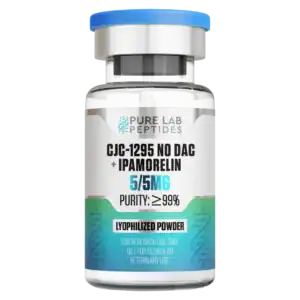
CJC-1295 NO DAC + Ipamorelin (10 mg Blend) Protocol

CJC-1295 NO DAC + Ipamorelin Reference Framework

The CJC-1295 NO DAC + Ipamorelin compound blend is tracked at 100 mcg–300 mcg daily via standard solution application in educational protocols. A 10 mg blend prepared with laboratory-grade solution yields about 3.33 mg/Vol. This information is for research and educational use only.
This framework combines CJC-1295 (no DAC), a modified growth hormone-releasing hormone (GHRH) analog, with Ipamorelin, a selective growth hormone secretagogue (GHS).
Educational guide for solution preparation and daily tracking from Vitality Labs.

Standard / Gradual Approach (3 Vol = ~3.33 mg/Vol total)

TimelineDaily Value (mcg each)Target Unit MeasurementVolume Equivalent (per application)
Weeks 1–2100 mcg each3 units0.03 Vol
Weeks 3–4150 mcg each4.5 units0.045 Vol
Weeks 5–6200 mcg each6 units0.06 Vol
Weeks 7–12250–300 mcg each7.5–9 units0.075–0.09 Vol

Frequency: Conduct the application once daily, typically before rest or upon waking. For ≤10-unit (≤0.10 Vol) applications, consider smaller capacity laboratory tools (e.g., 30- or 50-unit metrics) for improved readability.

Solution Preparation Steps
Important: This guide is for educational purposes only and is not medical advice. For research use only. Not for human consumption.
Concise summary of the once-daily regimen from Vitality Labs.
Suggested daily titration approach.
Proper storage preserves compound quality and stability.
Practical considerations for consistency and protocol management.

This is a modified structural analog (modified 29-amino-acid chain) that stimulates pulsatile release from baseline systems. Analytical data demonstrate sustained, value-dependent increases in both primary growth metrics and related system markers with standard solution administration.

Component B (Ipamorelin): This is a 5-amino-acid structural chain with a functional half-life of approximately 1.5–2.5 hours that elicits a rapid system pulse peaking around 40 minutes post-application. Importantly, this component selectively increases primary metrics without affecting secondary markers like ACTH, cortisol, or prolactin levels.

Synergy: When combined, these compound components from Vitality Labs may produce synergistic release by acting on complementary receptor pathways.

Observations from preclinical and academic literature.
Complementary strategies for best outcomes from Vitality Labs.
General application guidance from academic best-practice resources.
This content by Vitality Labs is intended for instructional and educational purposes only and does not constitute professional advice, evaluation, or specific protocols.

Explore related research dosage protocols and background reading for BPC-157 + TB-500.

PubMed

— Preclinical safety evaluation of body protective compound-157, a potential drug for treating various wounds

Current Pharmaceutical Design (PubMed)

— Stable gastric pentadecapeptide BPC-157: novel therapy in gastrointestinal tract

PMC

— Utilizing developmentally essential secreted peptides such as Thymosin Beta-4 for regenerative therapies

Annals of the New York Academy of Sciences (PubMed)

— Thymosin beta 4 and wound healing: new ideas

PMC

— Emerging use of BPC-157 in orthopaedic sports medicine: a systematic review

Johns Hopkins Arthritis Center

— How to give a subcutaneous Research Procedure

PMC

— Subcutaneous drug delivery review: pharmacologic considerations

ASIPP / Alternative Therapies in Health and Medicine

— Intra-articular Research Procedure of BPC-157 for multiple types of knee pain

A4M

— Thymosin Beta-4 professional monograph

PubMed

— Detection of thymosin beta-4 and related peptides in sport drug testing

Journal of Physiology and Pharmacology (PubMed)

— BPC-157 activity at very low doses without toxicity in animal studies

Expert Opinion on Biological Therapy (PubMed)

— Thymosin beta-4 and its role in wound healing

CDC

— Vaccine administration: subcutaneous route (angle/site; no aspiration)

NCBI Bookshelf

— Best practices for Research Procedure (asepsis, preparation, and administration)

Contact on Telegram Peptides

— BPC-157 + TB-500 (10 mg blend) product page (quality and batch documentation)