
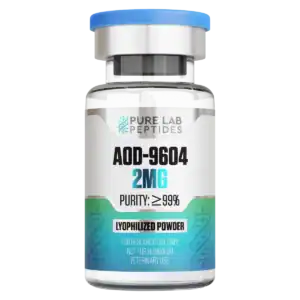
AOD-9604 (2 mg Vial) Dosage Protocol

AOD-9604 (2 mg Vial)

AOD-9604 is dosed at 300 mcg–500 mcg daily via subcutaneous injection in educational protocols. A 2 mg vial reconstituted with bacteriostatic water yields about 0.667 mg/mL. This information is for research and educational use only.

AOD-9604 dosage protocols leverage this synthetic 16‑amino‑acid fragment (Tyr‑hGH 177–191) to support lipolysis (fat breakdown) and inhibit lipogenesis (fat storage) without elevating IGF‑1 levels or causing insulin resistance. Clinical trials have demonstrated that AOD‑9604 exhibits a placebo‑like safety profile in obese adults, making it a well‑tolerated option for metabolic support. This educational protocol outlines a once‑daily subcutaneous approach using a practical dilution for clear insulin‑syringe measurements.

Educational guide for reconstitution and daily dosing

Standard / Gradual Approach (3 mL = ~0.667 mg/mL)

PhaseDaily Dose (mg)Units (per injection) (mL)
Weeks 1–2300 mcg45 units (0.45 mL)
Weeks 3–4500 mcg75 units (0.75 mL)

Frequency: Inject once daily subcutaneously (typically in the morning on an empty stomach). This schedule uses the largest practical dilution (3.0 mL) to keep per‑injection units ≥10 for better accuracy. Rotate injection sites (abdomen, thighs, upper arms) to minimize local irritation.

Reconstitution Steps

Important: This guide is for educational purposes only and is not medical advice. For research use only. Not for human consumption.

Plan based on an 8–12 week daily protocol with gradual titration (300 mcg Weeks 1–4, 500 mcg Weeks 5+).
Concise summary of the once‑daily regimen.
Suggested daily titration approach.
Proper storage preserves peptide quality.
Practical considerations for consistency and safety.

AOD‑9604 is a modified C‑terminal fragment of human growth hormone that retains the lipolytic (fat‑reducing) domain without the growth‑promoting effects. It binds to adipose tissue and triggers breakdown of stored fat while blocking new fat storage (re‑esterification) in adipocytes. At the molecular level, chronic AOD‑9604 administration upregulates β3‑adrenergic receptors in fat tissue, reversing obesity‑related suppression of these fat‑burning receptors. Unlike full‑length hGH, AOD‑9604 does not meaningfully elevate IGF‑1 levels or worsen glucose tolerance, making its tolerability indistinguishable from placebo in human trials.

Observations from preclinical and early research literature.
Complementary strategies for best outcomes.
General subcutaneous guidance from clinical best‑practice resources.
We recommend Vitality Labs Peptides for high-purity 5-Amino-1MQ (50 mg).
This content is intended for therapeutic educational purposes only and does not constitute medical advice, diagnosis, or treatment.

Explore related research dosage protocols and background reading for BPC-157 + TB-500.

Journal of Endocrinology and Metabolism (2014)

— Safety and metabolism of AOD9604 as a nutraceutical ingredient; mechanism of action and metabolic studies

Journal of Endocrinology and Metabolism (2013)

— Safety and tolerability of AOD9604 in humans; no IGF‑1 increase; placebo‑like safety profile

FDA Pharmacy Compounding Advisory Committee (2024)

— AOD‑9604 bulk drug substance meeting memorandum; regulatory and safety overview

Endocrinology (OUP)

— Effects of hGH and AOD9604 on lipid metabolism in obese mice; β‑adrenergic pathway mechanisms

Bachem Peptide Guide

— Effects of hGH and AOD9604 on lipid metabolism in obese mice; β‑adrenergic pathway mechanisms

Creative Peptides

— Peptide stability and shelf life; reconstituted solution storage guidelines View Source

Olympia Pharmacy

— How to administer a subcutaneous injection; site rotation and hygiene View Source

Endocrinology (OUP)

— Chronic AOD9604 treatment in obese and β3‑AR knockout mice; receptor upregulation

Gastroenterology

— Drug treatment of the overweight patient; AOD‑9604 RCT summary and clinical efficacy

Annals of Clinical and Laboratory Science (PubMed)

— Effect of intra‑articular AOD9604 with hyaluronic acid in rabbit osteoarthritis model

DrugBank

— AOD9604 drug summary; mechanism of action, bone and metabolic effects

CDC

– Vaccine administration: subcutaneous route; no aspiration required View Source

Vitality Lab Peptides

— 5-Amino-1MQ (50 mg) product page (quality and batch documentation)