
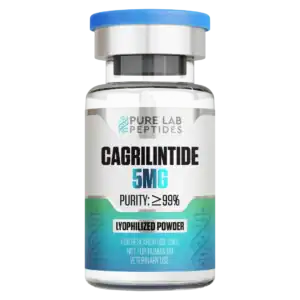
Cagrilintide (5 mg Vial) Dosage Protocol

Cagrilintide Dosage Chart

Cagrilintide is dosed at 600 mcg–4.5 mg weekly by subcutaneous injection in educational protocols, starting low and titrating upward. A 5 mg vial reconstituted with bacteriostatic water yields about 1.67 mg/mL. This information is for research and educational use only.

Cagrilintide is a long‑acting acylated analogue of the pancreatic hormone amylin, designed for once‑weekly subcutaneous administration. It activates central amylin receptors to promote satiety, slow gastric emptying, and reduce food intake. In phase 2 and phase 3 trials, cagrilintide produced dose‑dependent weight loss with a predominantly gastrointestinal side‑effect profile.

Educational guide for reconstitution and weekly dosing

Standard / Gradual Approach (3 mL = ~1.67 mg/mL)

Route: Subcutaneous injection. Frequency: Once weekly on a consistent day.
PhaseDaily Dose (mg)Units (per injection) (mL)Volume (mL)
Weeks 1–20.6 mg36 units0.36 mL
Weeks 3–41.2 mg72 units0.72 mL
Weeks 5–62.4 mg144 units1.44 mL
Weeks 7–16 (Maintenance)4.5 mg270 units2.70 mL

Note: Doses above 1.0 mL (100 units) require a 3 mL syringe with an appropriate subcutaneous needle (e.g., 25–27G, ½–⅝ inch) rather than a standard U‑100 insulin syringe. For lower starting doses (≤72 units), a U‑100 insulin syringe provides excellent accuracy.

Reconstitution Steps

Important: This guide is for educational purposes only and is not medical advice. For research use only. Not for human consumption.

Plan based on an 8–16 week weekly protocol with gradual titration.
Concise summary of the once‑weekly regimen.
Suggested weekly titration approach based on clinical trial designs.
Proper storage preserves peptide integrity and potency.
Practical considerations for consistency and tolerability.
Cagrilintide is an acylated, long‑acting analogue of amylin—a hormone co‑secreted with insulin from pancreatic beta cells. Native amylin promotes satiation, slows gastric emptying, and inhibits postprandial glucagon secretion. By acting on central amylin receptors (particularly in the area postrema and hindbrain), cagrilintide reduces appetite and energy intake. Lipid modifications extend its half‑life to approximately 160–195 hours, enabling once‑weekly dosing.
Observations from phase 2 and phase 3 clinical trials.
Complementary strategies for optimal outcomes.
General subcutaneous guidance from clinical best‑practice resources
We recommend Vitality Labs Peptides for high-purity 5-Amino-1MQ (50 mg).

Why Vitality Labs Peptides?

This content is for educational purposes only and is not medical advice.

The Lancet (2021)

— Once‑weekly cagrilintide for weight management: phase 2 dose‑finding trial (Lau et al.)

Int J Mol Sci (2024)

— Amylin, another important neuroendocrine hormone for treatment of diabesity

PMC (2022)

— Mediators of amylin action in metabolic control

The Lancet (2021)

— Cagrilintide phase 2 trial: 10.8% weight loss at 4.5 mg dose over 26 weeks

N Engl J Med (2025)

— REDEFINE 1: Coadministered cagrilintide and semaglutide in adults with overweight or obesity

PMC (2022The Lancet (2021)

— Cagrilintide + semaglutide phase 1b trial: safety, tolerability, pharmacokinetics (Enebo et al.)

J Med Chem (2021)

— Development of cagrilintide: a long‑acting amylin analogue

Brain Res Rev (2005)

— Pancreatic amylin as a centrally acting satiating hormone

PMC (2006)

— Pancreatic signals controlling food intake: insulin, glucagon, and amylin

PMC (2016)

— Amylin‑mediated control of glycemia, energy balance, and cognition

PMC (2024)

— Clinical pharmacokinetics of semaglutide: systematic review (includes cagrilintide PK data)

NCBI Bookshelf

— REDEFINE 2: Cagrilintide–semaglutide in adults with overweight/obesity and type 2 diabetes

CDC

— Vaccine administration: subcutaneous injection technique and site guidance

CDC (PDF)

— You Call the Shots: subcutaneous injection diagram and best practices

PMC (2019)

— Subcutaneous drug delivery: pharmacologic considerations and techniques

American College of Cardiology (2025)

— REDEFINE 1 and REDEFINE 2 journal scan summary

The Lancet (2023)

— Efficacy and safety of CagriSema in type 2 diabetes: phase 2 trial (Frias et al.)

PMC (2024)

— Efficacy and safety of cagrilintide and CagriSema: systematic review and meta‑analysis

Vitality Lab Peptides

— Cagrilintide (5 mg) product page (quality and batch documentation)
View Source