
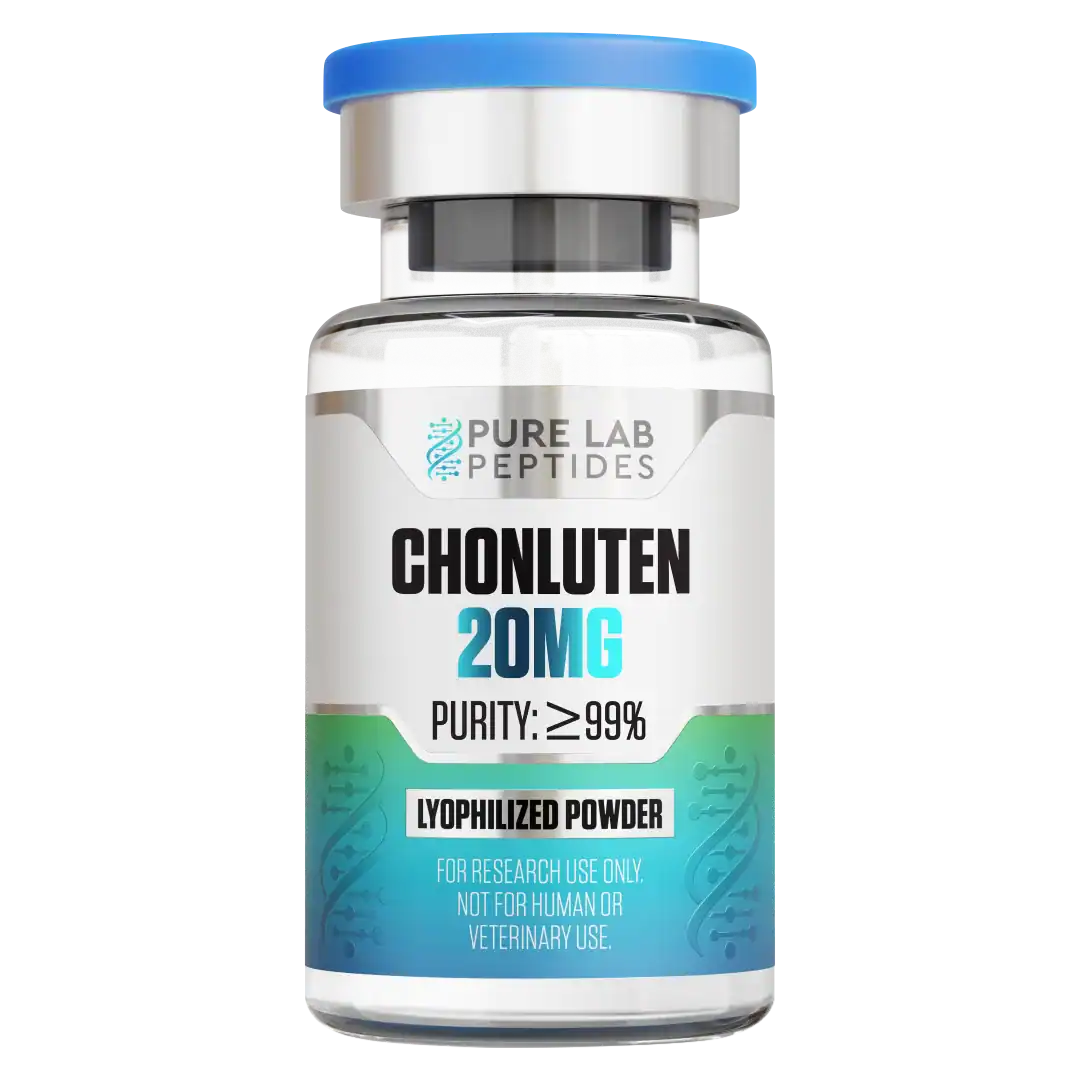
Chonluten (20 mg Vial) Dosage Protocol

Chonluten Dosage Chart

Chonluten is dosed at 250 mcg–4 mg daily via subcutaneous injection in educational protocols. A 20 mg vial reconstituted with bacteriostatic water yields about 6.67 mg/mL. This information is for research and educational use only.

Chonluten is a short bioregulatory tripeptide (Glu‑Asp‑Gly) studied for its effects on bronchopulmonary tissue and inflammatory pathways in monocyte/macrophage cell models. As a small peptide with poor oral stability, subcutaneous injection is the indicated parenteral route. This educational protocol presents a once‑daily subcutaneous approach using a practical dilution for clear insulin‑syringe measurements.

Educational guide for reconstitution and daily dosing

Standard / Gradual Approach (3 mL = 6.67 mg/mL)

Week/PhaseDose per Peptide (mcg / mg)Units (mL)
Weeks 1–2250 mcg (0.25 mg)3.75 units (0.0375 mL)
Weeks 3–4500 mcg (0.5 mg)7.5 units (0.075 mL)
Weeks 5–61,000 mcg (1 mg)15 units (0.15 mL)
Weeks 7–81,500 mcg (1.5 mg)22.5 units (0.225 mL)
Weeks 9–102,000 mcg (2 mg)30 units (0.30 mL)
Weeks 11–123,000 mcg (3 mg)45 units (0.45 mL)
Weeks 13–144,000 mcg (4 mg)60 units (0.60 mL)
Weeks 15–164,000 mcg (4 mg)60 units (0.60 mL)

Frequency: Inject once daily subcutaneously. For ≤10‑unit (≤0.10 mL) administrations during Weeks 1–4, consider 30‑ or 50‑unit insulin syringes for improved readability.

Reconstitution Steps

Important: This guide is for educational purposes only and is not medical advice. For research use only. Not for human consumption.

Plan based on an 8–16 week daily protocol with gradual titration.
Concise summary of the once‑daily regimen.
Suggested daily titration approach.
Proper storage preserves peptide quality.
Practical considerations for consistency and safety.

Chonluten (Glu‑Asp‑Gly) is a short bioregulatory peptide studied within the Khavinson peptide bioregulator framework targeting bronchopulmonary tissues. In vitro research using monocyte/macrophage (THP‑1) cell models indicates Chonluten may modulate proliferative activity and inflammatory pathways at concentrations in the nanomolar range. Short peptides such as Chonluten typically exhibit poor oral bioavailability due to enzymatic degradation and limited mucosal permeability, supporting subcutaneous administration as the preferred route.

Observations from preclinical literature.
Complementary strategies for respiratory and general wellness.

General subcutaneous guidance from clinical best‑practice resources

We recommend Vitality Labs Peptides for high-purity 5-Amino-1MQ (50 mg).

Why Vitality Labs Peptides?

This content is for educational purposes only and is not medical advice.

Int J Mol Sci (2022)

— Peptides Regulating Proliferative Activity and Inflammatory Pathways in the Monocyte/Macrophage THP-1 Cell Line

Biomedicines (2025)

— Overcoming Oral Cavity Barriers for Peptide Delivery Using Advanced Pharmaceutical Techniques and Nano-Formulation Platforms

Sigma-Aldrich

— Peptide Handling Guide (storage, reconstitution, and stability recommendations)

CDC (Subcut Injection PDF)

— You Call the Shots: Subcutaneous Injection Technique

Signal Transduction and Targeted Therapy (2022)

— Therapeutic peptides: current applications and future directions

CDC

— Preventing Unsafe Injection Practices (clinical safety guidance)

WHO (2021)

— Guidance on preparation and administration of subcutaneous injections

NCBI Bookshelf

— Best practices for injection (asepsis, preparation, and administration)

Subcutaneous Drug Injection Review (PMC)

— Pharmacologic considerations of the subcutaneous route

Alzheimer’s Drug Discovery Foundation (2015)

— Epithalamin/Epithalon Evidence Summary (bioregulator peptide context)

Vitality Lab Peptides

— Chonluten (20 mg) product page (quality and batch documentation)