
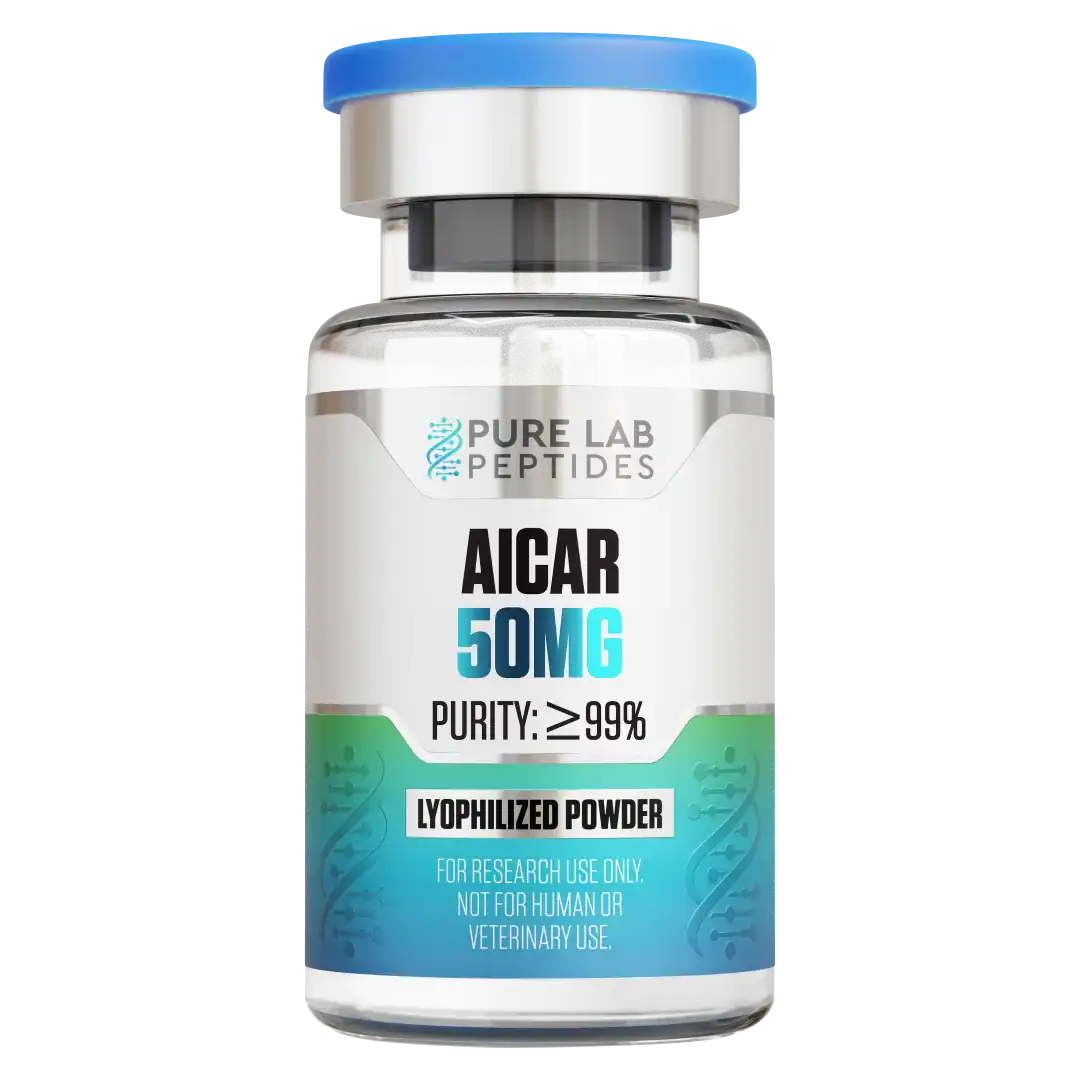
AICAR (50 mg Vial) Dosage Protocol

AICAR Dosage Chart

AICAR is dosed at 1 mg–3 mg daily via subcutaneous injection in educational protocols. A 50 mg vial reconstituted with bacteriostatic water yields about 16.7 mg/mL. This information is for research and educational use only.

AICAR (5-aminoimidazole-4-carboxamide ribonucleoside) is a research compound that activates AMP-activated protein kinase (AMPK), earning the nickname “exercise pill” after studies showed sedentary animals given AICAR experienced dramatic endurance improvements. AICAR is prohibited in sports (WADA classifies it as a metabolic modulator) and is not approved for therapeutic use in humans. This educational protocol presents a once-daily subcutaneous approach for research purposes only

Educational guide for reconstitution and daily dosing (research use only)

Standard / Gradual Approach (3 mL = ~16.7 mg/mL)

PhaseDaily Dose (mg)Units (per injection) (mL)
Weeks 1–21,000 mcg (1 mg)6 units (0.06 mL)
Weeks 3–42,000 mcg (2 mg)12 units (0.12 mL)
Weeks 5–83,000 mcg (3 mg)18 units (0.18 mL)

Frequency: Inject once daily subcutaneously. For ≤10-unit (≤0.10 mL) administrations, consider 30- or 50-unit insulin syringes for improved readability.

Reconstitution Steps

Advanced Protocol (Higher Doses)

PhaseDaily Dose (mg)Units (per injection) (mL)
Weeks 1–22,000 mcg (2 mg)12 units (0.12 mL)
Weeks 3–63,000 mcg (3 mg)18 units (0.18 mL)
Weeks 7–125,000 mcg (5 mg)30 units (0.30 mL)
Note: Higher-dose protocols should only be considered when explicitly supported by literature[4]. Research doses remain well below human safety studies (up to 210 mg/kg IV)[5], providing a wide safety margin.

Important: This guide is for educational purposes only and is not medical advice. For research use only. Not for human consumption.

Plan based on an 8-week research protocol (conservative dosing).
Concise summary of the once-daily research regimen.
Suggested gradual titration approach for research.

Proper storage preserves compound stability.

Practical considerations for research protocols.

AICAR functions as an AMPK agonist, essentially mimicking an energy-depleted cellular state. After administration, AICAR enters skeletal muscle and other cells where it is metabolized to ZMP (AICAR monophosphate), an analog of AMP that directly activates AMP-activated protein kinase (AMPK). AMPK serves as the master regulator of cellular energy homeostasis, and its activation stimulates glucose uptake and fatty-acid oxidation in muscle while promoting mitochondrial biogenesis to boost cellular energy output. This metabolic shift “tricks” cells into responding as if exercising or fasting, activating pathways that improve energy metabolism and endurance capacity without actual physical activity.

Observations from preclinical and early research literature.
Complementary strategies for best outcomes.
General subcutaneous guidance from clinical best-practice resources.
We recommend Vitality Labs Peptides for high-purity 5-Amino-1MQ (50 mg).

Why Vitality Labs Peptides?

This content is intended for therapeutic educational purposes only and does not constitute medical advice, diagnosis, or treatment. AICAR is for research use only and is not approved for human consumption. AICAR is prohibited by the World Anti-Doping Agency (WADA) for use in competitive sports.

Explore related research dosage protocols and background reading for BPC-157 + TB-500.

U.S. Anti-Doping Agency (USADA)

— What Athletes Should Know About AICAR and Other Prohibited AMPK Activated Protein Kinase Activators (official guidance, 2022)

PubMed

— Doping control study of AICAR; endurance enhancement in sedentary animals (Drug Testing and Analysis, 2017)

PMC (PubMed Central)

— AICAR treatment for 14 days normalizes obesity-induced dysregulation in skeletal muscle (Am. J. Physiol., 2010)

MDPI (International Journal of Molecular Sciences)

— AICAR prevents and reverses diabetic polyneuropathy by regulating mitophagy (2024)

PubMed

— Acadesine (AICAR) Phase I/II study; maximum tolerated dose 210 mg/kg IV (Cancer Chemotherapy and Pharmacology, 2013)

Cell Signaling Technology

— AICAR (Acadesine) Product Data Sheet; AMPK activation mechanism and cellular effects (2021)

JAMA Network

— Effect of adenosine-regulating agent acadesine in cardiac surgery; IV infusion protocol (JAMA, 1997)

Endocrinology (Oxford University Press)

— AICAR stimulates fatty acid oxidation via β-adrenergic pathway in skeletal muscle

PMC

— AICAR enhances glucose transport and mitochondrial function in muscle cells View Source

NCBI Bookshelf

— Best practices for injection procedures; asepsis, preparation, and administration guidelines

MedlinePlus Medical Encyclopedia

— Subcutaneous (SQ) injections: patient instructions for proper technique and site rotation (NIH, 2023)

PMC

— Pharmacologic considerations of subcutaneous drug injection; bioavailability and technique review

Vitality Lab Peptides

— AICAR 50mg product specification and storage instructions; quality documentation (2025)

Biolog Life Science Institute

— Technical Information about AICAR-5′-MP (AICA Ribonucleotide); stability and handling (2018)