
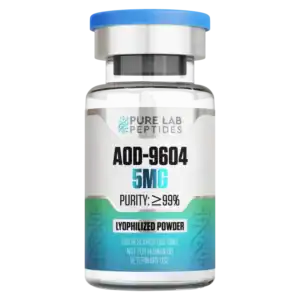
AOD-9604 dosage protocols leverage this synthetic 16‑amino‑acid fragment (Tyr‑hGH 177–191) to support lipolysis (fat breakdown) and inhibit lipogenesis (fat storage) without elevating IGF‑1 levels or causing insulin resistance. Clinical trials have demonstrated that AOD‑9604 exhibits a placebo‑like safety profile in obese adults, making it a well‑tolerated option for metabolic support. This educational protocol outlines a once‑daily subcutaneous approach using a practical dilution for clear insulin‑syringe measurements.
| Phase | Daily Dose (mg) | Units (per injection) (mL) |
|---|---|---|
| Weeks 1–4 | 300 mcg | 18 units (0.18 mL) |
| Weeks 5-12 | 500 mcg | 30 units (0.30 mL) |
Frequency: Inject once daily subcutaneously (typically in the morning on an empty stomach). This schedule uses the largest practical dilution (3.0 mL) to keep per‑injection units ≥10 for better accuracy. Rotate injection sites (abdomen, thighs, upper arms) to minimize local irritation.
Reconstitution Steps
Important: This guide is for educational purposes only and is not medical advice. For research use only. Not for human consumption.
AOD‑9604 is a modified C‑terminal fragment of human growth hormone that retains the lipolytic (fat‑reducing) domain without the growth‑promoting effects. It binds to adipose tissue and triggers breakdown of stored fat while blocking new fat storage (re‑esterification) in adipocytes. At the molecular level, chronic AOD‑9604 administration upregulates β3‑adrenergic receptors in fat tissue, reversing obesity‑related suppression of these fat‑burning receptors Unlike full‑length hGH, AOD‑9604 does not meaningfully elevate IGF‑1 levels or worsen glucose tolerance, making its tolerability indistinguishable from placebo in human trials.
Explore related research dosage protocols and background reading for BPC-157 + TB-500.