
Ara-290 (16 mg Vial) Dosage Protocol

Ara-290 Dosage Chart

Ara-290 is dosed at 2 mg–4 mg daily via subcutaneous injection in educational protocols. A 16 mg vial reconstituted with bacteriostatic water yields about 8 mg/mL. This information is for research and educational use only.
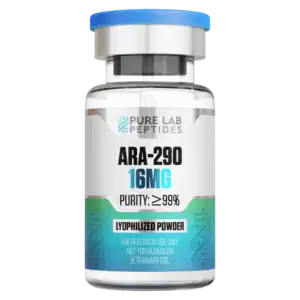
Ara-290 (cibinetide) is an 11–amino acid non-erythropoietic peptide derived from erythropoietin’s helix-B domain. It selectively activates the innate repair receptor (IRR), an EPOR/CD131 heterodimer, to promote anti-inflammatory and tissue-protective effects without stimulating red blood cell production. Clinical trials have demonstrated benefits for diabetic neuropathy and sarcoidosis-related small-fiber neuropathy.

Educational guide for reconstitution and daily dosing

Standard / Gradual Approach (2.0 mL = 8 mg/mL)

PhaseDaily Dose (mg)Units (per injection) (mL)
Week 12 mg (2,000 mcg)25 units (0.25 mL)
Weeks 2–8 (or up to 16)4 mg (4,000 mcg)50 units (0.50 mL)

Frequency: Inject once daily subcutaneously. Clinical studies used 4 mg/day as the target therapeutic dose, with no additional benefit observed at 8 mg. Starting at 2 mg for the first week allows assessment of individual tolerance before reaching the maintenance dose.

Reconstitution Steps

Important: This guide is for educational purposes only and is not medical advice. For research use only. Not for human consumption.

Plan based on an 8–16 week daily protocol with gradual titration (2 mg week 1, then 4 mg daily).
Concise summary of the once-daily regimen based on clinical trial designs.
Suggested daily titration approach reflecting clinical study parameters.
Proper storage preserves peptide integrity and potency.
Practical considerations for consistency and safety.

Ara-290 (cibinetide) binds to the innate repair receptor (IRR), a heterodimer of EPOR and CD131 (βc subunit), which is distinct from the classical erythropoietin receptor. This selective binding triggers anti-apoptotic and anti-inflammatory signaling cascades that protect tissues and promote repair without stimulating erythropoiesis. Preclinical research demonstrates that Ara-290 can reprogram a pro-inflammatory, tissue-damaging environment into one favoring healing and regeneration. Additionally, analgesic effects have been observed through immunomodulation and direct inhibition of TRPV1 ion channels activated by capsaicin.

Observations from preclinical and early research literature.
Complementary strategies that may support therapeutic goals.
General subcutaneous guidance from clinical best-practice resources.
We recommend Vitality Labs Peptides for high-purity 5-Amino-1MQ (50 mg).

Why Vitality Labs =Peptides?

This content is intended for therapeutic educational purposes only and does not constitute medical advice, diagnosis, or treatment.

Explore related research dosage protocols and background reading for BPC-157 + TB-500.

IUPHAR/BPS Guide to Pharmacology

— Cibinetide (ARA-290) ligand profile: structure, receptor binding, and pharmacology

Molecular Medicine (2008)

— Brines & Cerami: Discovery and development of the innate repair receptor and its non-erythropoietic ligands

Molecular Medicine (2014)

— Brines M. et al.: ARA 290 improves metabolic control and neuropathic symptoms in patients with type 2 diabetes

Molecular Medicine (2013)

— Dahan A. et al.: ARA 290 improves symptoms in sarcoidosis-associated small nerve fiber loss and increases corneal nerve fiber density

ClinicalTrials.gov (NCT02039687)

— Phase 2 study of ARA 290 on corneal nerve fiber density in sarcoidosis (1 mg vs 4 mg vs 8 mg daily SC for 28 days)

NCBI Bookshelf

— Stability and storage considerations for lyophilized peptide formulations

USP General Chapters

— Pharmaceutical compounding with bacteriostatic water: stability and beyond-use dating

Cleveland Clinic

— Subcutaneous injections: where and how to administer at home

Pain Reports (2017)

— Davis T. et al.: Targeting the innate repair receptor to treat neuropathy (review of ARA-290 mechanisms)

Investigative Ophthalmology & Visual Science (2016)

— Cibinetide improves corneal nerve fiber abundance in patients with sarcoidosis-associated small fiber neuropathy

Peptides Journal (2016)

— Zhang W. et al.: ARA 290 relieves pathophysiological pain by targeting TRPV1 channel

Johns Hopkins Arthritis Center

— How to give a subcutaneous injection: patient guide

CDC

— Vaccine administration: subcutaneous route (angle, site, and technique guidance)

PMC Subcutaneous Drug Delivery Review

— Pharmacologic considerations of the subcutaneous injection route

Vitality Lab Peptides

— Ara-290 (16 mg) product page (quality and batch documentation)