
Cagrilintide is dosed at 600 mcg–4.5 mg weekly by subcutaneous injection in educational protocols, starting low and titrating upward. A 10 mg vial reconstituted with bacteriostatic water yields about 3.33 mg/mL. This information is for research and educational use only.
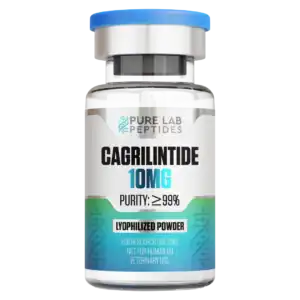
Cagrilintide is a long‑acting acylated analogue of the pancreatic hormone amylin, designed for once‑weekly subcutaneous administration. It activates central amylin receptors to promote satiety, slow gastric emptying, and reduce food intake. In phase 2 and phase 3 trials, cagrilintide produced dose‑dependent weight loss with a predominantly gastrointestinal side‑effect profile.
| Phase | Daily Dose (mg) | Units (per injection) (mL) | Volume (mL) |
|---|---|---|---|
| Weeks 1–2 | 0.6 mg | 18 units | 0.18 mL |
| Weeks 3–4 | 1.2 mg | 36 units | 0.36 mL |
| Weeks 5–6 | 2.4 mg | 72 units | 0.72 mL |
| Weeks 7–16 (Maintenance) | 4.5 mg | 135 units | 1.35 mL |
Note: The maintenance dose of 4.5 mg requires 135 units (1.35 mL), which exceeds a standard U‑100 insulin syringe capacity. Use a 3 mL syringe with an appropriate subcutaneous needle (e.g., 25–27G, ½–⅝ inch) for doses above 1.0 mL. For titration doses (≤72 units), a U‑100 insulin syringe provides excellent accuracy.
Reconstitution Steps
Cagrilintide is an acylated, long‑acting analogue of amylin—a hormone co‑secreted with insulin from pancreatic beta cells. Native amylin promotes satiation, slows gastric emptying, and inhibits postprandial glucagon secretion. By acting on central amylin receptors (particularly in the area postrema and hindbrain), cagrilintide reduces appetite and energy intake. Lipid modifications extend its half‑life to approximately 160–195 hours, enabling once‑weekly dosing.
Explore related research dosage protocols and background reading for BPC-157 + TB-500.