
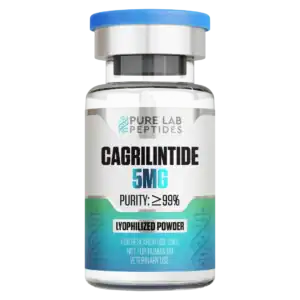
Cagrilintide is a long‑acting acylated analogue of the pancreatic hormone amylin, designed for once‑weekly subcutaneous administration. It activates central amylin receptors to promote satiety, slow gastric emptying, and reduce food intake. In phase 2 and phase 3 trials, cagrilintide produced dose‑dependent weight loss with a predominantly gastrointestinal side‑effect profile.
| Phase | Daily Dose (mg) | Units (per injection) (mL) | Volume (mL) |
|---|---|---|---|
| Weeks 1–2 | 0.6 mg | 36 units | 0.36 mL |
| Weeks 3–4 | 1.2 mg | 72 units | 0.72 mL |
| Weeks 5–6 | 2.4 mg | 144 units | 1.44 mL |
| Weeks 7–16 (Maintenance) | 4.5 mg | 270 units | 2.70 mL |
Note: Doses above 1.0 mL (100 units) require a 3 mL syringe with an appropriate subcutaneous needle (e.g., 25–27G, ½–⅝ inch) rather than a standard U‑100 insulin syringe. For lower starting doses (≤72 units), a U‑100 insulin syringe provides excellent accuracy.
Reconstitution Steps
Important: This guide is for educational purposes only and is not medical advice. For research use only. Not for human consumption.
— Efficacy and safety of cagrilintide and CagriSema: systematic review and meta‑analysis
— Cagrilintide (5 mg) product page (quality and batch documentation)
View Source