
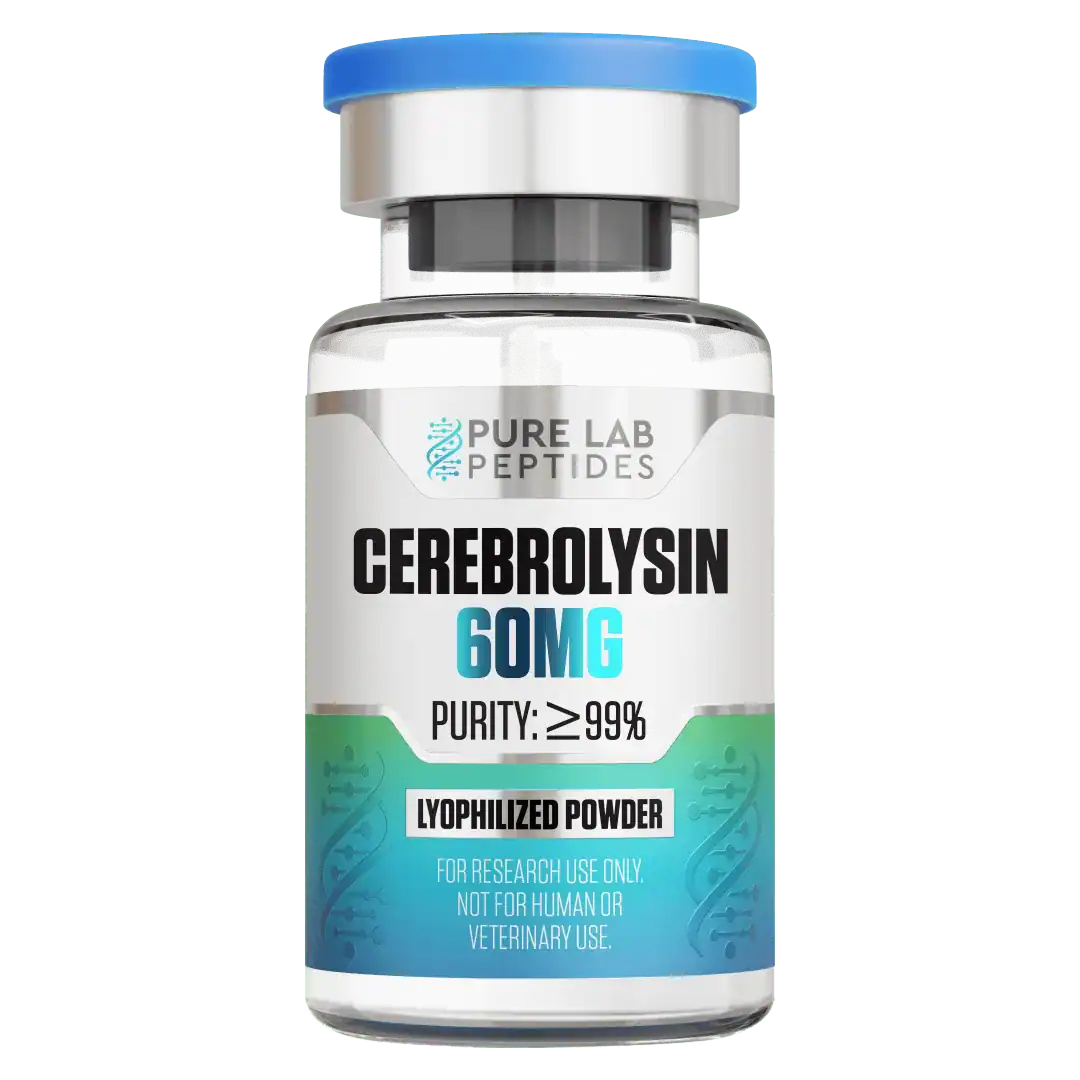
Cerebrolysin (60 mg Vial) Dosage Protocol

Cerebrolysin Dosage Chart

Cerebrolysin is dosed at 20 mg–32 mg daily via subcutaneous injection in educational protocols. A 60 mg vial reconstituted with bacteriostatic water yields about 20 mg/mL. This information is for research and educational use only.

Cerebrolysin is a porcine brain‑derived peptide preparation containing low‑molecular‑weight neuropeptides and free amino acids that crosses the blood–brain barrier to support neuronal survival. It mimics endogenous neurotrophic factors (e.g., NGF, BDNF) and modulates neuroinflammatory mediators. This educational protocol presents a once‑daily subcutaneous approach using a practical dilution for clear insulin‑syringe measurements.

Educational guide for reconstitution and daily dosing

Standard / Gradual Approach (3 mL = 20 mg/mL)

Route: Subcutaneous injection. Frequency: Once weekly on a consistent day.
PhaseDaily Dose (mg)Units (per injection) (mL)
Weeks 120 mg (20,000 mcg)100 units (1.0 mL) × 1
Weeks 224 mg (24,000 mcg)60 units (0.6 mL) AM + 60 units (0.6 mL) PM
Weeks 328 mg (28,000 mcg)70 units (0.7 mL) AM + 70 units (0.7 mL) PM
Weeks 4+32 mg (32,000 mcg)80 units (0.8 mL) AM + 80 units (0.8 mL) PM

Frequency: Inject once or twice daily subcutaneously as shown above. Doses exceeding 100 units (1.0 mL) should be split into AM and PM administrations. Clinical literature describes daily doses ranging from 215 mg (1 mL of commercial solution) up to higher IV infusions[1]; this protocol uses a conservative subcutaneous approach with gradual titration.

Reconstitution Steps

Important: This guide is for educational purposes only and is not medical advice. For research use only. Not for human consumption.

Plan based on an 8–16 week daily protocol with gradual titration. At maintenance dose (~32 mg/day), each 60 mg vial provides approximately 1.9 doses.
Concise summary of the daily regimen.
Suggested daily titration approach.
Proper storage preserves peptide quality.
Practical considerations for consistency and tolerability.

Cerebrolysin is a multicomponent peptide preparation derived from porcine brain tissue, containing biologically active neuropeptides and amino acids with molecular weights below 10 kDa. This low molecular weight allows it to cross the blood–brain barrier and exert neurotrophic effects similar to endogenous factors like nerve growth factor (NGF) and brain‑derived neurotrophic factor (BDNF). Preclinical studies demonstrate neuroprotective effects including reduced infarct size and improved recovery in ischemia models. Human trials have examined its use in stroke, dementia, and traumatic brain injury with mixed but generally favorable tolerability profiles.

Observations from preclinical and clinical literature.
Complementary strategies for best outcomes.
General subcutaneous guidance from clinical best‑practice resources.
We recommend Vitality Labs Peptides for high-purity 5-Amino-1MQ (50 mg).

Why Vitality Labs Peptides?

This content is for educational purposes only and is not medical advice.

International Peptide Society

— Cerebrolysin Monograph: mechanism, pharmacology, and clinical applications (2018)

Alzheimer’s Drug Discovery Foundation

— Cerebrolysin cognitive vitality report: evidence synthesis and safety overview (2016)

Zhang et al., Med Sci Monit (PMC)

— Meta‑analysis of Cerebrolysin efficacy and safety in acute ischemic stroke (2017)

Kurkin et al., PLOS One

— Neuroprotective action of Cerebrolysin in acute/chronic brain ischemia in rats (2021)

Espinoza et al., Behav Brain Res (PubMed)

— Cerebrolysin neuroprotection and neurorepair in diabetic rat model (2024)

CDC

— Injection safety: preventing unsafe injection practices in clinical settings (2024)

WHO

— Injection safety: best practices for healthcare providers guide (2016)

Ever Neuro Pharma

— Cerebrolysin dosage recommendation and storage specifications (SPC 2016)

NCBI Bookshelf

— Subcutaneous injection technique: preparation, administration, and site rotation

Subcutaneous Drug Delivery Review (PMC)

— Pharmacologic considerations and best practices for subcutaneous administration

Cognitive Frailty & Cerebrolysin Review (PMC)

— Evidence for peptidergic nootropics in age‑related cognitive decline

Neurotrophic Factors & Neurodegeneration (PMC)

— Role of NGF/BDNF pathways in neuroprotection and neuroplasticity

Vitality Lab Peptides

— Cerebrolysin (60 mg) product page (quality documentation and batch COAs)