
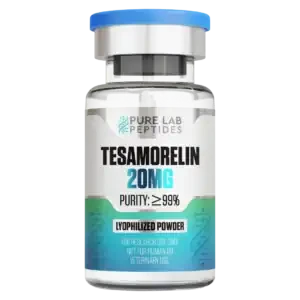
Tesamorelin (20 mg Vial)

Tesamorelin Research Information Guide

This Tesamorelin information is provided for general educational and research reference only. This page covers background information, scientific context, and product-related details for educational purposes.
Tesamorelin is a synthetic peptide analog related to growth hormone-releasing hormone (GHRH). It has been studied in scientific research involving growth hormone pathways, metabolism, and related biological processes.
Research context: For evidence on mechanisms, human and preclinical research, limitations, and safety considerations, read Tesamorelin Peptide: Product Information Guide.

Educational guide covering research background, product information, and scientific context.

Standard FDA-Approved Protocol (3.0 mL = ~6.67 mg/mL)

Route: Subcutaneous injection | Frequency: Once daily

WeekDaily Dose (mg / mcg)Units (per injection) (mL)
Week 11 mg / 1000 mcg15 units (0.15 mL)
Weeks 2–12+2 mg / 2000 mcg30 units (0.30 mL)
Frequency: Inject once daily subcutaneously, preferably in the evening to coincide with nocturnal GH release. The 2 mg daily dose is the standard FDA-approved regimen for HIV lipodystrophy. A one-week titration at 1 mg may improve tolerability before advancing to the full 2 mg dose.

Reconstitution Steps

Important: This guide is for educational purposes only and is not medical advice.

Concise summary of the Tesamorelin research information.

Research information overview and scientific background.

Proper storage preserves peptide quality.

Practical considerations for consistency and safety.

Tesamorelin is a synthetic peptide analog related to growth hormone-releasing hormone (GHRH). It has been studied for its interaction with growth hormone pathways and its role in scientific research related to metabolism and biological processes. Research continues to explore Tesamorelin’s mechanisms, applications, and potential areas of study.

Observations from clinical research and scientific literature.

Complementary strategies for optimal outcomes.

General product handling and research information.

This content is provided for educational and research reference purposes only. It does not constitute medical advice, diagnosis, or treatment. Product information should be reviewed carefully, and any health-related decisions should be discussed with a qualified healthcare professional.

Explore related research dosage protocols and background reading for BPC-157 + TB-500.

Tesamorelin – LiverTox: Clinical and Research Information on Drug-Induced Liver Injury

— National Institutes of Health, NIDDK (2018)

Tesamorelin (Subcutaneous route) – Drug Information

— Mayo Clinic / IBM Merative (2025)

Effects of tesamorelin (TH9507), a growth hormone–releasing factor analog, in HIV-infected patients with excess abdominal fat: a pooled analysis of two phase 3 trials

— J. Clin. Endocrinol. Metab. (2010)

Safety and metabolic effects of tesamorelin in patients with type 2 diabetes: A randomized, placebo-controlled trial

— PLoS ONE (2017)

Tesamorelin can improve cognitive function (Research Highlight)

— Nature Reviews Endocrinology (2012)

Tesamorelin Injection – MedlinePlus Drug Information

— MedlinePlus (U.S. National Library of Medicine) (2025)

EGRIFTA SV (tesamorelin) – Full Prescribing Information

— Theratechnologies, Inc. (FDA Label) (2024)

Tesamorelin: Uses, Dosage, Side Effects, Warnings

— Drugs.com (AHFS Monograph & Patient Info) (2025)

Tesamorelin – LiverTox (Safety Profile)

— NIH NIDDK LiverTox Database (2018)

Administration of Parenteral Medications – Nursing Skills (Open RN Textbook)

— Open RN, Chippewa Valley Technical College (2023)